Minimalist vs. Tactical: How to Define Your Gear Philosophy

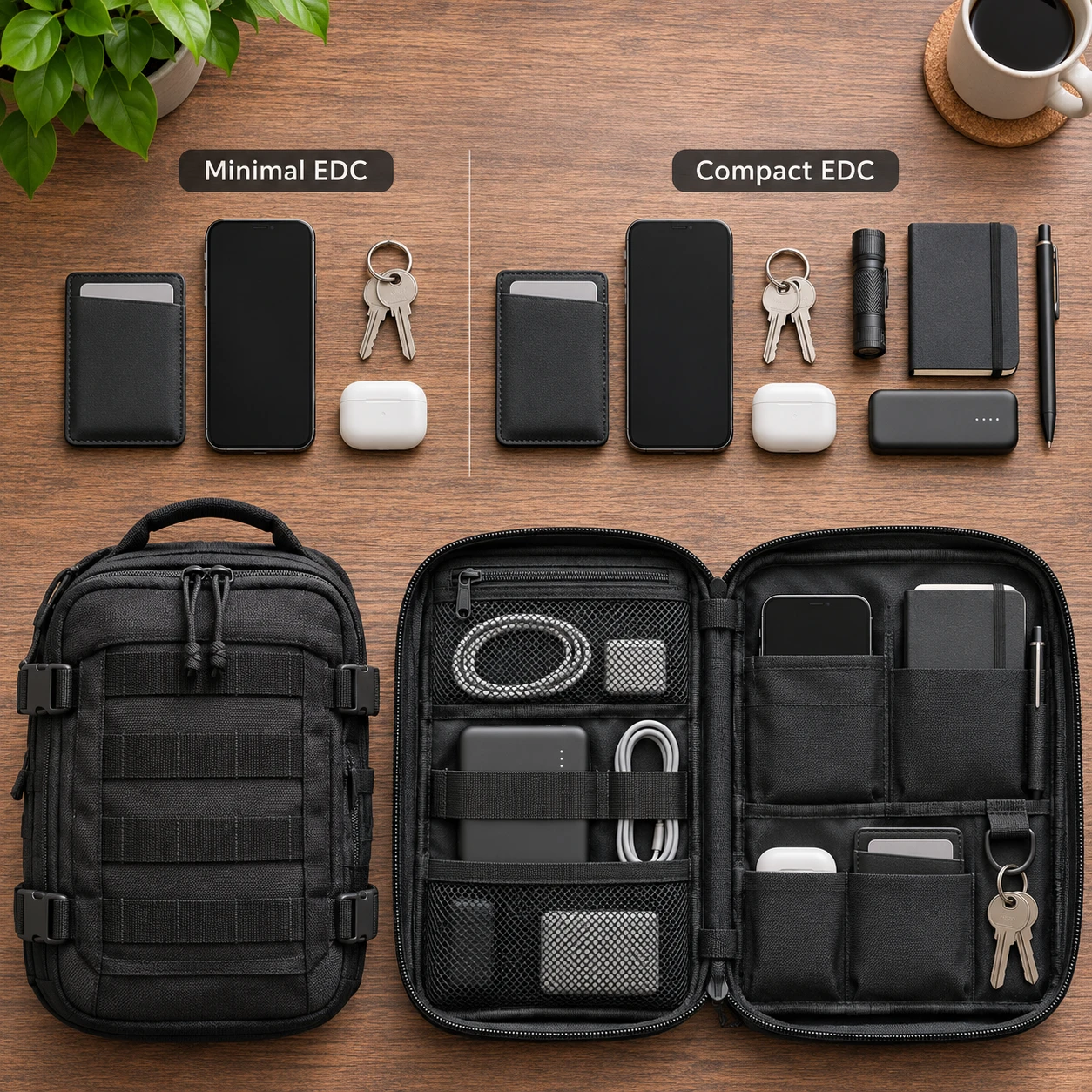
Everyday gear should make ordinary routines easier, whether that means carrying a few essentials in your pockets or keeping a well-organized bag close at hand. The choice between minimalist and tactical gear is less about appearance than about what you value: simplicity, readiness, comfort, or specialized organization.
Neither philosophy is automatically better. The right approach depends on what you do each day, what you need within reach, and how much weight and complexity you are willing to carry. Many people settle on a practical mix rather than following either style strictly.
What “minimalist” and “tactical” mean in everyday gear
Minimalist gear favors a small number of compact, versatile essentials, while tactical gear emphasizes durability, structured organization, and quick access. Both can support everyday carry (EDC); they simply solve different problems.
A minimalist setup starts with limits: carry only what earns its place. Its design tends to be low-profile and uncomplicated, with fewer pockets, attachments, or specialized features. A wallet, phone, keys, and one useful tool might be enough for someone whose day is predictable and whose needs are modest.
Tactical gear takes a more prepared and organized approach. It may use rugged materials, multiple compartments, reinforced construction, and attachment points to keep items separated and accessible. The label describes a design influence, not a requirement to prepare for combat or emergencies. A commuter, photographer, or hands-on worker might appreciate the layout for ordinary tasks.
Think of the distinction as a starting question: do you want to reduce what you carry, or improve how you carry a wider set of items? Functionality matters in both cases, but each defines useful functionality differently.
The minimalist philosophy: carry less, choose carefully
The minimalist philosophy is to carry fewer items and choose each one for regular, practical use. This can reduce bulk, simplify decisions, and make everyday carry more comfortable.
A compact setup works especially well when you move between meetings, errands, transit, and home without needing a lot of equipment. Fewer items are easier to account for and often fit comfortably in a pocket or small bag. The strongest minimalist choices are versatile: one item that serves several routine purposes can be more useful than several single-purpose extras.
Still, “less” is not a reliable measure of quality. Removing an item you use every day may create hassle, while choosing the smallest version of something can make it awkward to handle. Minimalist gear also depends on your routine staying within the limits of what you carry. If plans change often, leaving no room for a charger, notebook, or other frequent need can turn simplicity into inconvenience.
To test a minimalist setup, track what you actually use for a typical week. Keep the items that solve recurring problems; question the ones you carry only because they might come in handy someday. That is a more useful filter than aiming for an arbitrary number of items.
The tactical philosophy: prioritize readiness and organization
The tactical philosophy prioritizes durable construction, clear organization, and easy access to a broader range of everyday items. It suits routines where carrying extra tools or supplies has a practical purpose.
Divided compartments can keep frequently used items separate from things you reach for less often. A sturdy bag may also stand up to regular commuting, outdoor use, or work environments where lighter materials wear quickly. In that sense, tactical design is about managing tasks and gear, not simply adding rugged-looking details.
There are trade-offs. More pockets can make it harder to remember where you put something, and a larger, more structured bag can add weight even when it is not full. Extra straps, attachment points, and reinforced panels are useful only if your routine calls for them. Otherwise, they can make gear more cumbersome without improving its functionality.
A simple test is to identify the items you need to reach quickly and the ones you need to carry safely through the day. Choose organization around those real tasks. If a compartment or feature never serves a clear purpose, it may be complexity rather than utility.
Key trade-offs: weight, comfort, versatility, and complexity
The key trade-off is that minimalist gear usually reduces bulk, while tactical gear often offers more structure and capacity. Your best choice balances weight, comfort and mobility, durability, versatility, and organization against the demands of your day.
Weight and comfort: A smaller load can feel easier during a long walk or crowded commute. But minimalist gear is not always lighter: a compact item made from heavy materials can outweigh a simpler alternative. Tactical bags can carry weight more comfortably when designed to distribute it well, though a large bag can tempt you to pack unnecessary extras.
Durability and versatility: Reinforced construction may withstand frequent, rough use, but it can add weight or cost. Lightweight gear can be easy to carry and versatile, yet may not be the right choice for demanding conditions. Match durability to wear and tear you actually expect, not an imagined worst-case scenario.
Organization and complexity: Separate compartments make a larger kit easier to sort, but every added feature creates another decision about where things belong. Minimalist setups keep choices simple, though a small pouch or limited storage may be frustrating when you routinely carry varied items.
One useful way to compare options is to consider the full carrying system, not just an item’s materials or appearance: what goes in it, how far you carry it, how often you access it, and where it lives when you are not using it.
Which philosophy fits your routine?
Minimalist gear fits routines that are light, predictable, and mobile; tactical gear fits routines that benefit from extra capacity, durable construction, and organized access. Your personal lifestyle, not a style label, should guide gear selection.
Consider how your day changes from morning to evening. A person who walks between appointments and carries only daily essentials may prefer a low-profile setup. Someone who moves between work sites and needs a notebook, cables, and other tools may value a structured bag. Travel, weather, workplace rules, and access to storage can all change what makes sense.
Ask yourself these questions:
- Which items do I use on most days, rather than merely carry out of habit?
- Do I need to reach particular items quickly, or is compactness more important?
- How much walking, standing, or transit does my routine involve?
- Will my gear face regular wear, moisture, or rough handling?
- Do I need capacity for changing plans, or can I pack for a predictable day?
Answer with a real week in mind, including the inconvenient days. A setup that feels perfect at home may become uncomfortable after a long commute. Likewise, a small everyday kit can be a poor fit if you regularly need work supplies and have nowhere else to store them.
A blended approach to everyday carry
A blended everyday carry combines a compact set of essentials with selected tactical features that solve specific problems. You can keep the overall load streamlined while adding organization or durability where your routine benefits from it.
For example, someone might keep phone, keys, and wallet simple, then use a small, divided bag for work items. Another person could carry a compact daily setup but choose a more durable pouch for equipment that gets handled often. The principle is to add a feature because it has a job, not because the style suggests it should be there.
Try a three-layer approach:
- Core: items you use almost every day, such as your phone, keys, and payment method.
- Routine-specific: items needed for work, commuting, hobbies, or recurring errands.
- Occasional: items carried only for particular plans, which may belong in a separate bag rather than your daily setup.
This separates genuine everyday needs from occasional ones. It also lets you adjust without rebuilding your entire kit. The compromise is that a modular setup may take a little more planning, especially when you switch bags or activities.
A simple framework for choosing your gear
Choose everyday gear by listing recurring needs, testing comfort, and removing features that do not earn their space. A short review of your actual routine is more dependable than choosing a philosophy based on looks alone.
Use this four-step check before adding or replacing gear:
- List: Write down the items you use on a normal day and those needed for recurring activities.
- Sort: Separate daily essentials from occasional extras. Keep occasional items in activity-specific storage when practical.
- Test: Carry your setup for several ordinary days. Notice discomfort, clutter, delays finding items, or needs you could not meet.
- Edit: Remove unused items, then add a feature only when it fixes a problem you observed.
Reassess when your routine changes, such as starting a commute, changing jobs, or taking up a regular activity. Otherwise, a quick check every few months is usually enough to catch items that have become dead weight or needs that have changed.
The goal is a dependable setup that feels comfortable and supports your real day. Minimalism helps when carrying less improves your mobility; tactical organization helps when structure and capacity save time. Let use determine the mix.
Frequently asked questions
Is minimalist gear always lighter? No. Minimalist gear often reduces the number or size of items, but material and construction affect weight. Compare the complete setup you will carry.
Does tactical gear make sense for everyday use? It can, especially when durability, accessible storage, or multiple compartments solve everyday problems. If those features go unused, a simpler option may be more comfortable.
Can minimalist and tactical styles be combined? Yes. Keep daily essentials compact and add only the organization or rugged construction your routine calls for.
How often should I reassess my everyday carry? Review it when your schedule or needs change, and consider a brief check every few months. Remove items you no longer use and address repeated frustrations.